

How Long It Takes to Marginalize a Negative Google Result
November 10, 2026
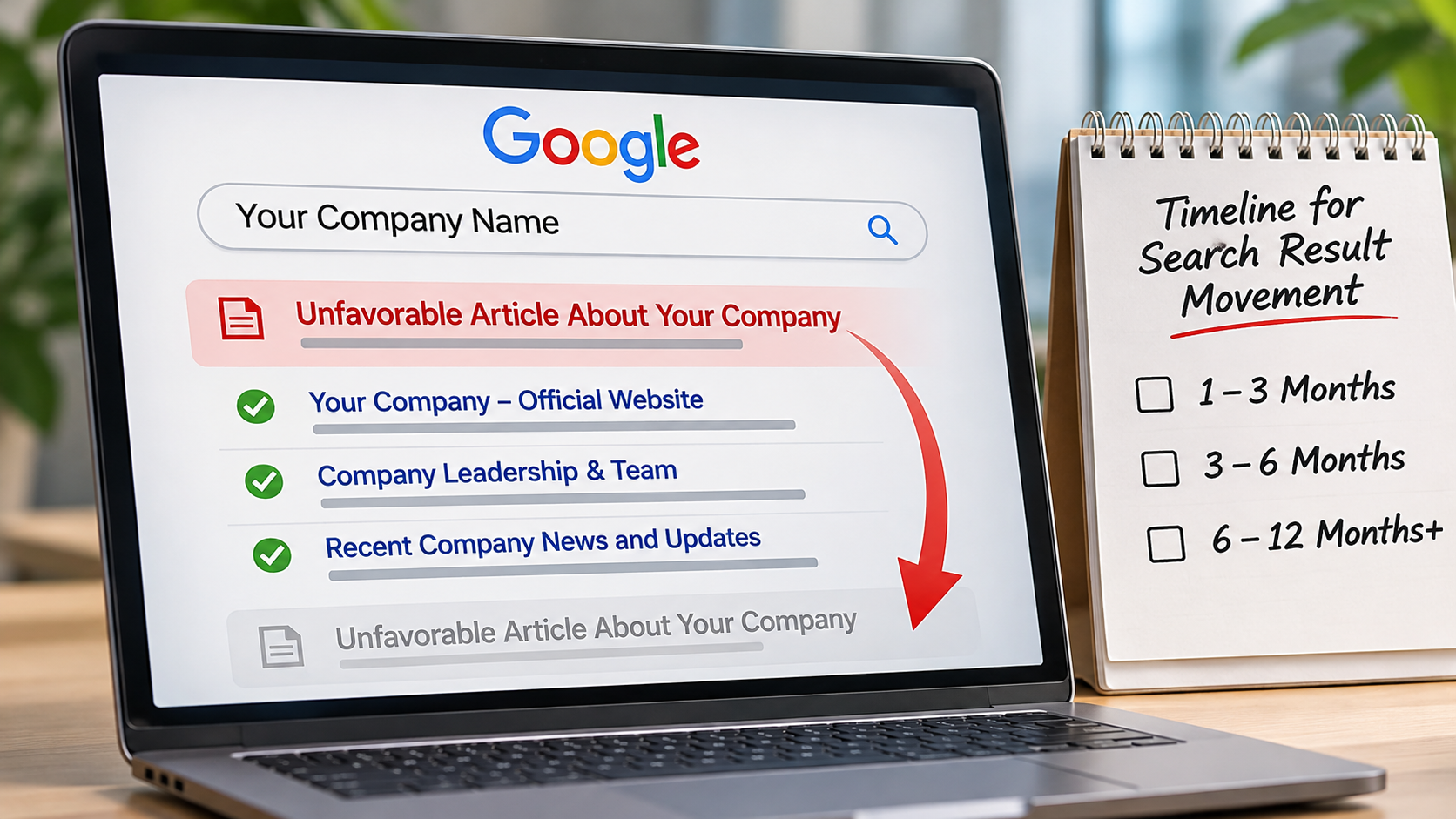
When a negative article, review or profile appears prominently in Google, the first question is often how long it will take to diminish its visibility. The honest answer is that there is no universal timeline, because Google is not responding to a removal request or a switch that can be turned off; it is continually deciding which pages are most relevant and useful for a particular search, and a negative result decreases in its ranking and hence has less prominence only when other pages earn stronger positions above it.
That distinction matters because publishing several favorable articles does not automatically displace an established result. The new or strengthened pages must first be crawled and indexed, then demonstrate enough relevance, authority and usefulness to compete for the same search term, while the negative page may already have years of history, links from other websites and a close connection to the person or company being searched. A realistic estimate therefore begins with the strength of the existing result and the quality of the assets available to challenge it, not with a standard promise of 4 weeks, 8 weeks or many months.
A Realistic Timeline for Search Result Movement
The first stage is discovery. Google states that crawling a new or updated page can take from a few days to a few weeks, and requesting a recrawl does not guarantee immediate inclusion or a particular ranking. This means the first several weeks of a reputation project may produce little visible movement even when the underlying work is sound, because Google is still discovering, processing and comparing the relevant pages.
Early changes may appear within one to three months when the negative result is relatively weak, the branded search is not highly competitive and credible existing assets can be improved rather than built from nothing. Examples might include an outdated post on a low-authority website, a result sitting near the bottom of page one, or a search landscape in which the company website, executive biography and established professional profiles already rank nearby. Even in these circumstances, early movement should be treated as an indicator rather than a completed outcome, because positions can fluctuate as Google continues testing different results.
Three to six months is a more useful assessment period for many projects because it allows time to strengthen several assets, build consistent signals and observe whether the negative result is losing ground across repeated searches. Google cautions that some search improvements can take effect within days while others can take several months to produce a visible effect, and it provides no guarantee that changes will create a noticeable ranking improvement. If stronger pages are steadily moving upward during this period, the strategy may be working even if the negative result has not yet left page one.
Six to twelve months or longer may be required when the negative page belongs to a major news organization, government website, court-record platform or authoritative industry publication; when it ranks in the first few positions for an exact personal or company name; or when it has accumulated links and remained prominent for years. In difficult cases, the relevant outcome may be gradual displacement rather than complete disappearance, and some results may remain resistant unless the source page is corrected, removed or overtaken by several genuinely stronger assets.
What Determines Whether the Result Moves
Current position is one of the clearest starting points. Moving a result from position nine to position twelve requires one credible page to pass it and removes it from the first page for many users, while moving a result from position one to position eleven requires an entire first page of competing results to become more relevant. The work may look similar from the outside, but the scale of the ranking change is completely different.
The authority and relevance of the source also matter. A weak article may rank because little else exists for the search, in which case strengthening the company website, executive profiles, reputable interviews and accurate third-party coverage can change the balance relatively quickly. A detailed article from an established publication is harder to displace because the domain is frequently crawled, widely referenced and already trusted for many subjects, while an article centered directly on the searched name may remain highly relevant even if it is old.
Age is not a ranking guarantee, but established pages often have advantages that new pages must earn. An Ahrefs analysis of millions of URLs found that 72.9 percent of pages in Google’s top ten were more than three years old and that only a small proportion of newly published pages reached the top ten within one year. The study covers search rankings generally rather than reputation campaigns specifically, but it helps explain why publishing new content is not the same as immediately gaining a first-page position.
The existing digital footprint can shorten or extend the timeline. A company with an established website, regularly updated leadership pages, active professional profiles and credible media coverage has assets that can be strengthened, interconnected and made more useful. A person or organization with almost no accurate online presence must first build those assets and allow them to develop history, which generally makes the process slower. The search term itself also changes the difficulty: a distinctive personal name may have fewer competing pages, but a negative article focused entirely on that name can be exceptionally relevant, while a common name may require additional work to establish which pages refer to the correct individual.
Removal and suppression should also be separated. If information is factually wrong, violates a website policy, qualifies for removal under applicable law or can be corrected by the publisher, resolving the source may be faster and more reliable than trying to outrank it. When lawful and accurate content remains online, however, the practical task is to improve the overall search landscape by developing information that is current, authoritative and genuinely valuable to someone researching the subject.
In addition, there needs to be a certain level of discretion and judgement made by any company offering these services to ensure the public is still able to access critical truthful information on search engines. That means, as we sometimes do, politely turning down offers from potential clients. As stated on our website – we choose our clients as much as our clients choose us.
How to Measure Progress Without Making False Promises
Success should be defined before work begins. Moving a result down three positions, removing it from the first page and making it effectively invisible are different objectives, and each demands a different level of effort. The target searches should be documented, rankings should be measured consistently, and progress should be evaluated across the full first page rather than by looking only at the negative URL. New positive or neutral assets entering the top ten, existing assets gaining positions and the negative result appearing for fewer related searches can all represent meaningful progress before page-one suppression is complete.
Longer-term evidence also demonstrates why patience matters. In an observational study involving 102 physicians researchers compared Google results over a two-year period and found that negative comments moved down by an average of approximately nine positions, while the proportion appearing beyond the first page increased substantially. The study examined a specific professional setting and should not be treated as a universal benchmark, but it shows that meaningful improvement can accumulate over time rather than occur immediately after new profiles or content are published.
Reporting should therefore distinguish activity from impact. The number of articles published, profiles updated or links secured describes the work performed, while ranking movement shows whether Google is responding. If credible assets remain static after several months, the answer is not simply to publish more of the same material; the strategy may need stronger sources, better alignment with the search intent, clearer differentiation between similarly named entities or improvements to assets that already possess authority.
A responsible estimate is ultimately a range based on evidence. A weak result near the bottom of page one may move within a few short months, while a top-ranking article on a powerful domain can require a year or longer and may never disappear completely through suppression alone. Anyone promising a fixed position by a fixed date is claiming control over a search system they do not control. The more credible approach is to assess the search landscape, explain the variables, establish measurable milestones and show whether stronger, more accurate information is steadily earning greater visibility.